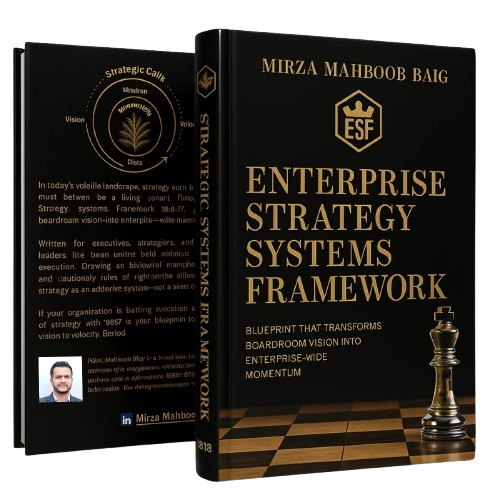

Enterprise Strategy Systems Framework (ESSF)
A practical blueprint for strategy leaders navigating transformation in a VUCA world.
Enterprise Strategy Systems Framework (ESSF)
A practical blueprint for strategy leaders navigating transformation in a VUCA world.
Book Overview
Enterprise Strategy Systems Framework (ESSF) is a practical, systems-based approach that helps leaders turn ambitious strategies into measurable results. Built around the concept of Strategic Cells—the smallest meaningful units of execution—ESSF provides clarity, accountability, and adaptability across complex organizations.
By integrating the 6Ws (Why, What, Who, How, When, Where) and the Data–Knowledge–Wisdom cycle, ESSF transforms strategy into a living system that learns, adapts, and delivers sustainable outcomes. It offers leaders a repeatable architecture for transformation, tools to manage constraints with foresight, and a pathway to operationalize agility while preserving strategic coherence.
Book Overview
Enterprise Strategy Systems Framework (ESSF) is a practical, systems-based approach that helps leaders turn ambitious strategies into measurable results. Built around the concept of Strategic Cells—the smallest meaningful units of execution—ESSF provides clarity, accountability, and adaptability across complex organizations.
By integrating the 6Ws (Why, What, Who, How, When, Where) and the Data–Knowledge–Wisdom cycle, ESSF transforms strategy into a living system that learns, adapts, and delivers sustainable outcomes. It offers leaders a repeatable architecture for transformation, tools to manage constraints with foresight, and a pathway to operationalize agility while preserving strategic coherence.
Inside the Book (ESSF)
A quick glimpse into the core ideas, frameworks, and case studies explored in Enterprise Strategy Systems Framework (ESSF). Each chapter builds on the last to transform strategy from intent into impact.
Chapter I: The Imperative for ESSF
This chapter highlights why a new approach to strategy is urgently needed. It explores how governance gaps, strategic misalignment, and lack of accountability have caused major corporate failures, from Abraaj to NMC Health. In today’s VUCA world, traditional strategy models fail because they stop at planning without bridging the gap to execution. The Enterprise Strategy Systems Framework (ESSF) is introduced as a universal, adaptive model designed to close this gap—turning vision into reality with clarity, agility, and accountability.
Chapter II: Foundational Concepts of ESSF
This chapter introduces the “Unit Cell” approach—the idea that strategy, like complex systems, must be built from its smallest operational component. It explains how Strategic Initiatives act as the unit cells of strategy, transforming limited resources into clarity, innovation, and measurable outcomes. By balancing structural design (frameworks and organization) with functional execution (processes, tools, and systems), ESSF ensures strategies cascade effectively from corporate vision down to operational action—keeping alignment, agility, and accountability intact.
Chapter III: The Enterprise Strategy Systems Framework (ESSF)
This chapter presents ESSF as a unified, adaptive framework that transforms strategy into a living system. By combining the Data–Knowledge–Wisdom cycle with the 6Ws (Why, What, Who, How, When, Where), ESSF enables organizations to bridge vision and execution through structured, iterative processes. Rooted in systems thinking, its methodology integrates strategy, processes, and technology, while its holistic approach emphasizes cross-functional collaboration, feedback loops, and continuous learning—ensuring strategies remain agile, measurable, and sustainable.
Chapter IV: Operationalizing Strategy
This chapter explains how ESSF transforms vision into execution by linking strategic design with measurable delivery through Strategic Initiatives (SIs). ESSF provides the structure, tools, and models, while SIs bring focus, accountability, and impact. Together, they create a data-driven, responsive system for sustainable outcomes. The chapter also highlights how program and portfolio management within ESSF enables organizations to prioritize, govern, and monitor initiatives—ensuring resources are optimized and strategies remain aligned with enterprise goals.
Chapter V: The Full Cycle of Strategy Management
This chapter introduces the continuous cycle of strategy—from insight to execution—anchored in the Data, Knowledge, and Wisdom (DKW) model. Strategy begins with data-driven research, evolves into knowledge through exploration and design, and culminates in wisdom via execution and adaptive learning. By embedding feedback loops at every stage, the ESSF ensures strategies stay relevant, resilient, and performance-driven, enabling organizations to align vision with real-world outcomes.
Endorsement Quotes
"Great Book Mirza, It is obvious that you have put great effort and dedication into this book wish you and readers great success understanding and implementing it’s contents “The Enterprise Strategy Systems Framework (ESSF) is a thoughtful and well-structured guide that bridges the gap between strategic intent and operational reality. Mirza Mahboob Baig has succeeded in distilling complex enterprise dynamics into a framework that is both practical and visionary. As a business leader, I find this work to be a valuable tool for diving alignment, clarity, and execution across large organizations.”

"The ESSF framework offers leaders a logical sequence that starts with theoretical concepts and leads to practical execution tools. It stands out for its clarity and includes ready-to-use models with structured explanations that enhance its effectiveness in real-world organizational settings"

"In fintech and financial services, strategy execution is no longer a top-down mandate—it’s a dynamic, adaptive process shaped by constant market shifts and evolving customer needs. The real challenge lies in translating bold vision into practical action across the organization. ESSF meets this challenge head-on, offering a pragmatic and structured approach that breaks down complexity into executable components. It empowers teams to align, innovate, and create sustainable value. Congratulations to Mirza on delivering a timely and impactful contribution to the field of strategic leadership"

"For enterprises scaling AI or data transformation, ESSF uniquely links between ambition and trusted outcomes. It makes strategy continuously measurable, provenance-aware, and future-proof. ESSF resonates as a theory but also as an essential data-first doctrine."

"At Takadao, we believe systems must serve people—not control them. ESSF reflects this same ethos, offering a strategic framework where collaboration, transparency, and shared ownership drive meaningful, scalable impact."

"ESSF gets strategy out of the slide deck and into the operating system of the enterprise. It turns purpose into disciplined execution, with feedback that compounds learning across programs and teams."

"The ESSF is a compelling system for leaders navigating complexity—it transforms strategy into a living process, aligning people, purpose, and performance at every level."

"Analysis of the Enterprise Strategy Systems Framework (ESSF) reveals 79 instances of the concept of stakeholders. This suggests that strategy is meaningless without consideration of external perceptions of the organization's legitimacy and reputation. To succeed, the organization's leadership at all levels will be better situated only after considering what others in the organization's business ecosystem need, especially those who are likely to support the organization with energy and resources. The relevance and effectiveness of the ESSF, and connection to stakeholders can be gleaned from a healthy emphasis on the importance of relationships, collaboration, and cooperation, all highlighted by application of the "6W" approach, one element of which seeks to underscore "Who" needs to be involved, informed, and integrated into the ESSF application. Congratulations to Mirza Mahboob Baig for an insightful and novel approach to strategy work."

The book “Enterprise Strategy Systems Framework (ESSF)” stands as a distinguished reference for every leader aspiring to translate strategic visions into tangible results within highly complex work environments. The author excels in highlighting the comprehensiveness of strategy, underscoring that unless it penetrates the core work of an organization’s smallest units, it will not yield its full impact at the institutional level. A truly pioneering work that deserves to be read and reflected upon by anyone seeking excellence in leadership and organizational transformation.

In an era where execution defines success, ESSF offers the missing link; a practical way to align incentives and KPIs with strategy, empowering organizations to stay focused, agile, and accountable.